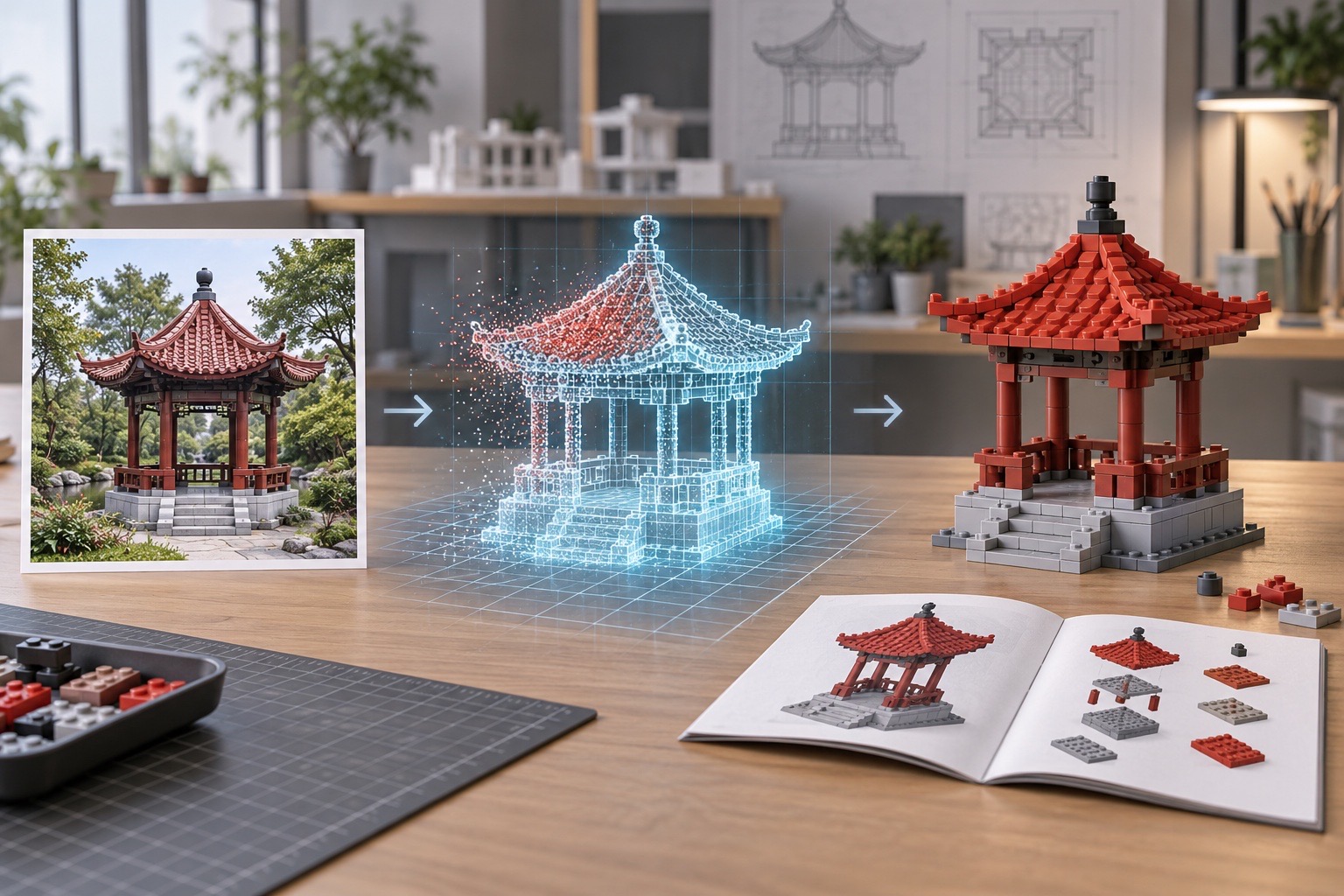
2026 research is closing the gap between a single image and a usable 3D asset. It does not automatically solve brick catalog selection, connection topology, color availability, collision-free placement, stability, or build order. Those require a separate discrete engineering layer.
“Image to 3D” now describes several outputs: textured meshes, Gaussian scenes, simulation-ready articulated assets, and conversational design loops. For brick builders, the useful question is not which model makes the prettiest mesh. It is which intermediate signals can help a constraint-driven brick engine.
Four systems worth watching
Seed3D 2.0: geometry before detail
Fact ByteDance describes a two-stage approach: a larger DiT first establishes coarse topology and spatial layout, then a second stage restores sharp edges and surface detail. Its published evaluation used 60 experienced 3D evaluators across roughly 200 test cases against six baselines.
Inference For a brick pipeline, the coarse stage may be more valuable than the texture stage. Brick conversion must identify large volumes, symmetry, roofs, supports, and cavities before choosing individual parts.
TRELLIS: keep more than one 3D representation
Fact Microsoft’s TRELLIS page says the same structured latent can produce meshes, radiance fields, and 3D Gaussians, supports local editing, and can create a textured mesh from one image in under ten seconds on an A100.
Inference A brick system could use a mesh for surface targets, a volumetric representation for occupancy, and a graph for final connectivity instead of forcing one representation to do every job.
AssetGen: latency changes the product
Fact The AssetGen paper reports a mesh with baked normals, textures, and controlled polygon count in 30 seconds from one image; its Flash variant targets 14-second previews.
Inference Faster previews enable a better workflow: confirm the silhouette, adjust scale, then spend compute on brick mapping and validation. This is more useful than waiting for a polished result built on the wrong interpretation.
PhysX-Anything: physical attributes become first-class
Fact PhysX-Anything presents a single-image framework that generates explicit geometry, articulation, and physical attributes for simulation-ready assets.
Inference Brick models need a different physics vocabulary—clutch, anti-studs, pins, axles, legal offsets, and load paths—but the broader direction is important: shape alone is not enough.
The missing brick-specific layer
and prompt
A production brick workflow needs five additional operations after 3D reconstruction: quantize shape to the stud grid, select real part-and-color combinations, establish legal connection topology, validate collisions and support, and find a human-accessible assembly order.
What this means for Image2LEGO
The near-term opportunity is orchestration, not claiming that one frontier model solves everything. Vision and 3D systems can propose shape; a multimodal model can clarify intent and critique results; deterministic tools should own part catalogs, coordinates, connectivity, inventory, and exports. The user remains the final reviewer.
Use fast previews to confirm intent early, preserve uncertainty instead of hiding it, and expose the exact transition from visual evidence to discrete parts.
Primary sources
Sources were checked on October 1, 2026. Statements marked “Fact” summarize published claims. Statements marked “Inference” are Image2LEGO editorial analysis and do not imply that Image2LEGO implements the referenced research systems.