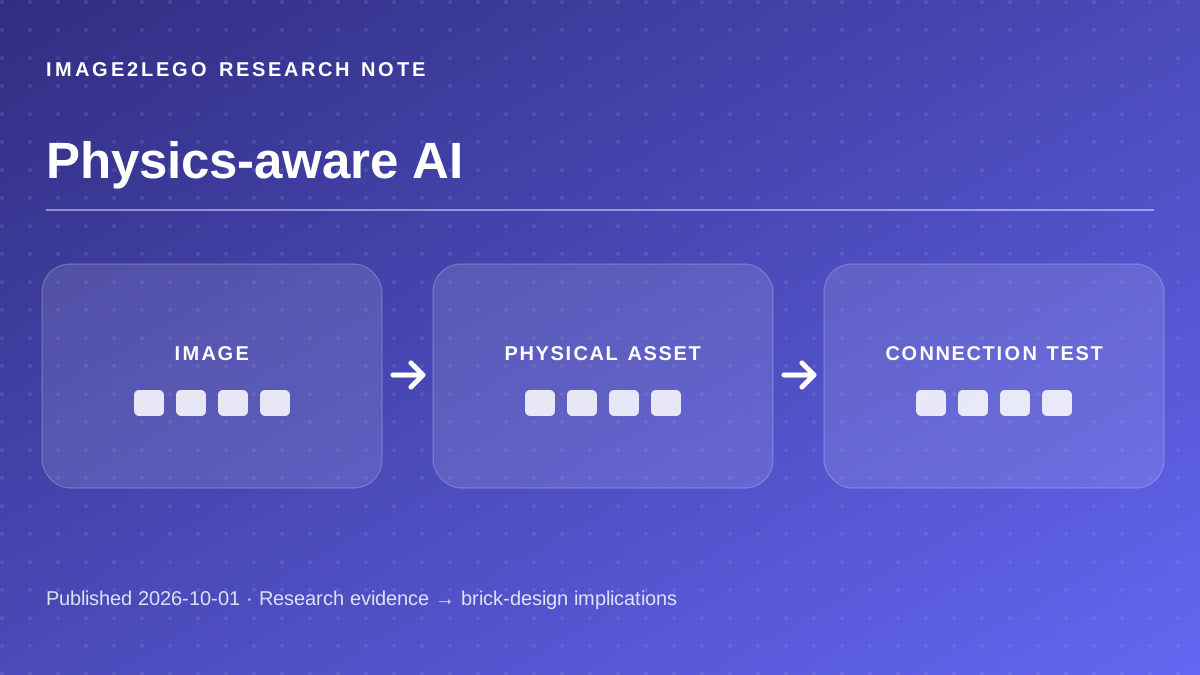
This is a useful reminder that shape, motion and material behavior should not be collapsed into one pretty render. A hinged door or turning wheel has functional requirements that a static preview cannot prove. The research discussed here is independent of Image2LEGO; this article does not claim that the website implements those systems.
“simulation-ready physical 3D assets”
— PhysX-Anything project page. Short excerpt quoted for analysis; the source’s results do not measure Image2LEGO.
What the new physical asset contains
Source factPhysX-Anything, presented at CVPR 2026, takes a single image and produces assets with explicit geometry, articulation and physical attributes. Its project page reports a 193-fold reduction in geometry-token count in its representation and a dataset with more than 2,000 annotated objects. Those figures describe its research system, not brick-model accuracy. [1]
Brick-design analysisThis is a useful reminder that shape, motion and material behavior should not be collapsed into one pretty render. A hinged door or turning wheel has functional requirements that a static preview cannot prove.
Identify which parts of your intended brick build must move and which must remain rigid before generating a model.
General physics is not clutch geometry
Source factMuJoCo models contacts and dynamics for simulated articulated systems. BrickGPT addresses a narrower task and describes validity checks plus physics-aware rollback during brick generation. [2] [3]
Brick-design analysisA simulation-ready object may have plausible mass and articulation while still using illegal stud offsets or unsupported brick connections. Brick rules require geometry at the part level.
Check every hinge, axle, pin and stud interface in a brick editor. A generic physics score is not a substitute for connection validation.
Static stability versus assembly order
Source factA physically stable final pose does not prove that a person can assemble the model in the proposed sequence. The cited physics research focuses on simulation-ready assets rather than step-by-step brick instructions. [1] [2]
Brick-design analysisA roof can appear supported once complete but require an impossible floating placement halfway through the instructions. Buildability includes intermediate states, reachability and part insertion paths.
Walk through instructions in order and mark the first unsupported or inaccessible placement; revise the sequence before sharing.
Use physics claims carefully
Source factThe PhysX-Anything demonstrations validate simulation tasks in a MuJoCo-style environment. They do not establish compatibility with LEGO part catalogs or real clutch strength. [1] [3]
Brick-design analysisFor AI-assisted brick design, research on physical attributes can inform future checks, but consumer claims should be limited to checks actually performed in the product.
Separate three statements in any review: looks plausible, passes software connection checks, and has been physically test-built. They are different evidence levels.
Questions builders ask
Does physics-aware AI guarantee a stable LEGO build?
No. General physical attributes do not verify individual part connections, assembly order or real-world clutch.
What should I test first?
Start with connection legality and obvious unsupported spans, then inspect intermediate assembly steps.
Primary sources and editorial method
Every external capability and research number above is attributed to the original project or standard. “Brick-design analysis” and “Try this” are practical inferences, not claims that Image2LEGO uses the named model or has validated a physical build.
Sources checked October 1, 2026. Research results may depend on benchmark, hardware, model checkpoint and input conditions. No third-party demo video or image is reproduced here.