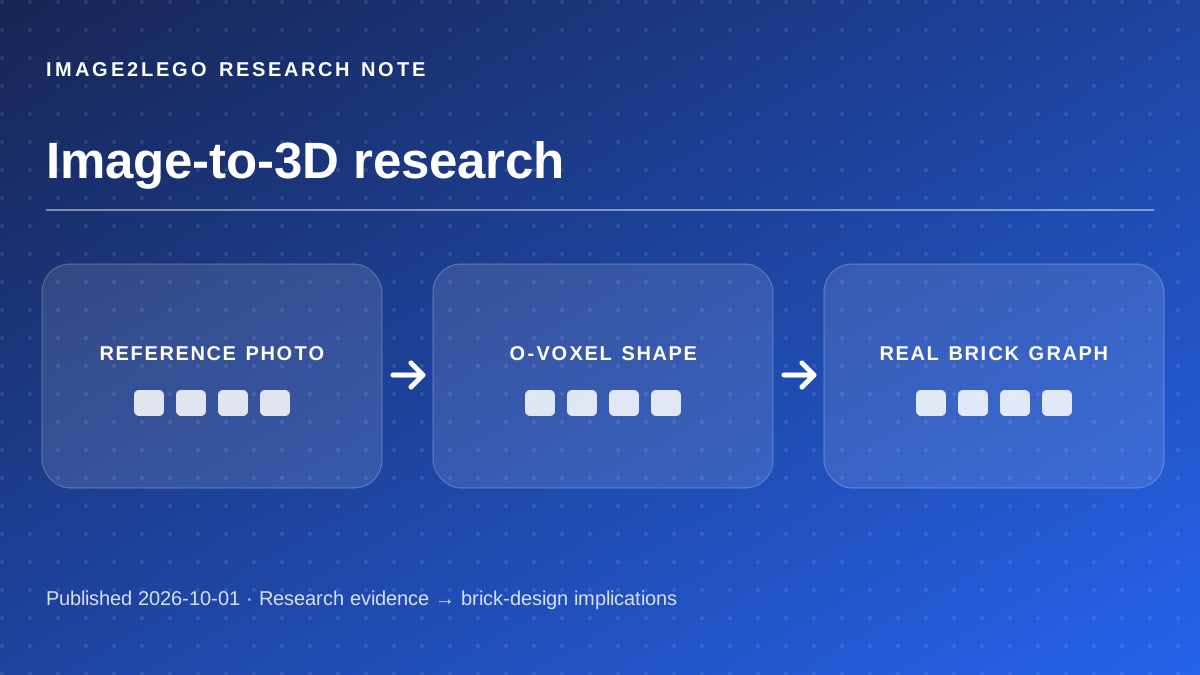
For a brick workflow, the useful output is a shape hypothesis: silhouette, broad volume, cavities and perhaps material regions. Photorealistic surface detail is less valuable when the final palette consists of discrete colors and standardized parts. The research discussed here is independent of Image2LEGO; this article does not claim that the website implements those systems.
“high-fidelity image-to-3D generation”
— Microsoft TRELLIS.2 repository. Short excerpt quoted for analysis; the source’s results do not measure Image2LEGO.
What TRELLIS.2 demonstrably produces
Source factMicrosoft describes TRELLIS.2 as a 4-billion-parameter image-to-3D model. Its O-Voxel representation is designed for complex topology, sharp features and physically based material channels such as roughness and opacity. The repository reports roughly 3 seconds for a 512³ asset and 17 seconds for a 1024³ asset on an H100; those are research-hardware measurements, not a promise for a consumer website. [1]
Brick-design analysisFor a brick workflow, the useful output is a shape hypothesis: silhouette, broad volume, cavities and perhaps material regions. Photorealistic surface detail is less valuable when the final palette consists of discrete colors and standardized parts.
Compare the generated silhouette from front, side and top. If any of those views is wrong, fix the shape before mapping pieces.
Why mesh resolution is not brick resolution
Source factA high-resolution mesh stores surfaces. LDraw, by contrast, describes a model using part references and transformations in a text-based format. BrickNet research treats connections and spatial relations among parts as first-class structure. [2] [3]
Brick-design analysisSimply voxelizing a mesh can create floating blocks, impossible offsets or thousands of tiny pieces. A useful converter needs a legal part catalog, grid alignment, connection rules, collision checks and a manageable build sequence.
Ask for an actual parts list and open an LDraw export in a compatible editor. A glossy GLB preview alone is not evidence of a buildable model.
The missing colors-and-materials step
Source factTRELLIS.2 can model PBR properties, including metallic and opacity. Real brick inventories use a finite set of part-and-color combinations, not an arbitrary texture at every surface point. [1] [2]
Brick-design analysisA principled pipeline should cluster colors, preserve important contrasts and check whether each proposed color exists for the selected part. Transparent windows and metallic finishes need explicit catalog choices rather than a texture baked into a mesh.
Prioritize two or three defining colors in your image prompt. Treat subtle shading as lighting, not as a requirement for many extra brick colors.
A more honest pipeline
Source factThe cited TRELLIS.2 work is about generating 3D assets; it does not claim to generate LEGO-compatible part graphs or assembly instructions. [1] [2] [3]
Brick-design analysisA robust architecture would use reconstruction to propose geometry, then run separate discrete optimization and validation before creating steps and exports. The geometric model is evidence for the brick plan, not the finished deliverable.
Evaluate five outputs separately: shape, actual part IDs, legal connections, build order and editable export. A failure in any one should be visible to the user.
Questions builders ask
Can TRELLIS.2 export a LEGO model directly?
The published TRELLIS.2 system generates 3D assets, not verified LEGO part files. A separate brick-conversion stage is required.
Is a higher mesh resolution always better?
No. Better shape evidence can help, but excessive surface detail can make the final brick design more expensive and less coherent.
Primary sources and editorial method
Every external capability and research number above is attributed to the original project or standard. “Brick-design analysis” and “Try this” are practical inferences, not claims that Image2LEGO uses the named model or has validated a physical build.
Sources checked October 1, 2026. Research results may depend on benchmark, hardware, model checkpoint and input conditions. No third-party demo video or image is reproduced here.