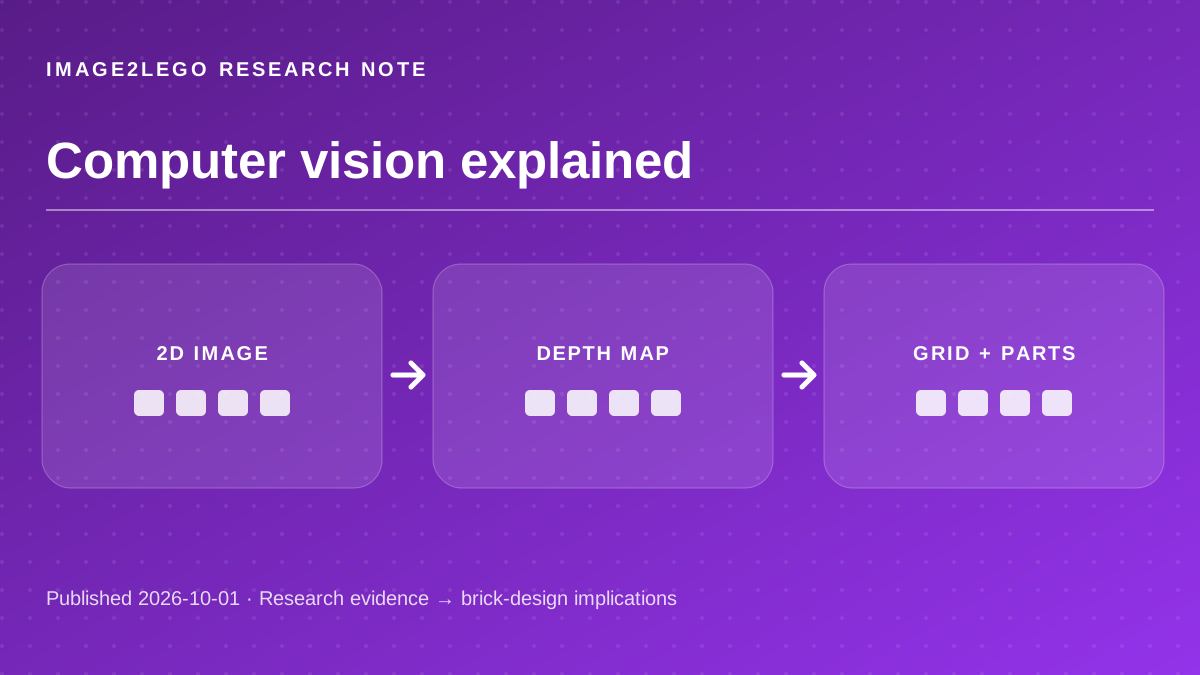
Relative depth helps distinguish a projecting roof from the wall behind it, or a foreground tree from a building. It does not by itself tell you that a model should be exactly 24 studs wide. The research discussed here is independent of Image2LEGO; this article does not claim that the website implements those systems.
“A More Capable Foundation Model for Monocular Depth Estimation”
— Depth Anything V2 official repository. Short excerpt quoted for analysis; the source’s results do not measure Image2LEGO.
What the model estimates
Source factDepth Anything V2 is a monocular depth-estimation family. Its official repository lists 24.8-million-, 97.5-million- and 335.3-million-parameter released variants. Its standard pre-trained models predict relative depth; separate metric-depth models are also documented. [1]
Brick-design analysisRelative depth helps distinguish a projecting roof from the wall behind it, or a foreground tree from a building. It does not by itself tell you that a model should be exactly 24 studs wide.
Choose a target footprint or one known dimension before converting a depth map into brick coordinates.
Occlusion is the hard part
Source factA depth estimator reasons over visible pixels in one view. It cannot directly observe surfaces hidden behind the object. Multi-view systems such as VGGT add camera and point-map information when more images are available. [1] [2]
Brick-design analysisThe rear of a car, the underside of a bridge or the inside of a building can be plausible inventions rather than observations. A build plan should mark those areas as estimated.
Use a side or rear reference if a hidden face determines structure. If none exists, simplify the unseen geometry deliberately.
Translate continuous depth to a stud grid
Source factA depth image is a continuous field. LDraw models are built from discrete part references with positions and orientations. [1] [3]
Brick-design analysisThe conversion needs a scale choice, a depth threshold, stepwise surfaces and part selection. Naively assigning one brick per pixel would exaggerate noise and make an unbuildable or excessively detailed result.
Reduce the image to major depth layers—foreground, body and background—then allocate brick thickness to each layer. Preserve the silhouette first.
A useful photo-selection test
Source factDepth Anything V2’s authors emphasize fine-grained detail and robustness, but published model capability does not eliminate ambiguity caused by reflections, transparent materials or flat lighting. [1]
Brick-design analysisFor a consumer workflow, a strong reference image has a clear outline, visible side planes and a few prominent depth breaks. A beautifully lit image with a busy background can be harder to model than a plain product shot.
Before uploading, crop around one subject and check that the roofline, wheels or other signature protrusions remain obvious at thumbnail size.
Questions builders ask
Does a depth map create the back of an object?
No. It estimates distances on visible pixels. Hidden geometry still needs other views, assumptions or manual design.
Can depth tell me the exact number of bricks?
Not alone. Scale, part catalog, color choices and stability rules determine the final count.
Primary sources and editorial method
Every external capability and research number above is attributed to the original project or standard. “Brick-design analysis” and “Try this” are practical inferences, not claims that Image2LEGO uses the named model or has validated a physical build.
Sources checked October 1, 2026. Research results may depend on benchmark, hardware, model checkpoint and input conditions. No third-party demo video or image is reproduced here.