For brick design, a splat can help inspect an object from new viewpoints and reveal visually important features. It is a reference layer, not a bill of materials. The research discussed here is independent of Image2LEGO; this article does not claim that the website implements those systems.
“high-quality real-time (≥ 100 fps) novel-view synthesis”
— Inria 3D Gaussian Splatting project. Short excerpt quoted for analysis; the source’s results do not measure Image2LEGO.
What splatting solved
Source factThe Inria team’s SIGGRAPH 2023 paper introduced a scene representation using 3D Gaussians and reported real-time novel-view rendering at 1080p and at least 100 frames per second in its research setting. The method represents appearance efficiently; it is not a catalog of manufactured pieces. [1]
Brick-design analysisFor brick design, a splat can help inspect an object from new viewpoints and reveal visually important features. It is a reference layer, not a bill of materials.
Use a reconstruction to decide which side views or architectural details matter before building the part model.
Why appearance is not geometry
Source factGaussian splats are optimized for view synthesis. LDraw model files instead describe explicit pieces and transformations. The difference remains even when a splat looks photorealistic from several angles. [1] [2]
Brick-design analysisA fuzzy edge can render correctly without defining wall thickness, a solid underside or a legal connection. Brick conversion therefore needs an explicit geometry or occupancy stage and then discrete part placement.
Check whether a proposed export contains editable part IDs. If it is only a point cloud or splat file, it is not yet a brick design.
Capture quality still matters
Source factThe original 3DGS workflow starts from photos and camera calibration. Modern geometry estimators such as VGGT can infer camera and point information from visual views, but both approaches depend on useful image evidence. [1] [3]
Brick-design analysisReflective, transparent or moving subjects can create uncertain shapes. A small brick build rarely needs photorealistic texture, but it does need reliable outer dimensions and supporting surfaces.
Walk around a static subject with overlapping shots. Avoid changing the object’s pose between views, and include the base in at least one image.
Use the right representation at each stage
Source factThe source systems do not claim to output stable brick assembly instructions. Their published goals are visual reconstruction and rendering. [1] [2]
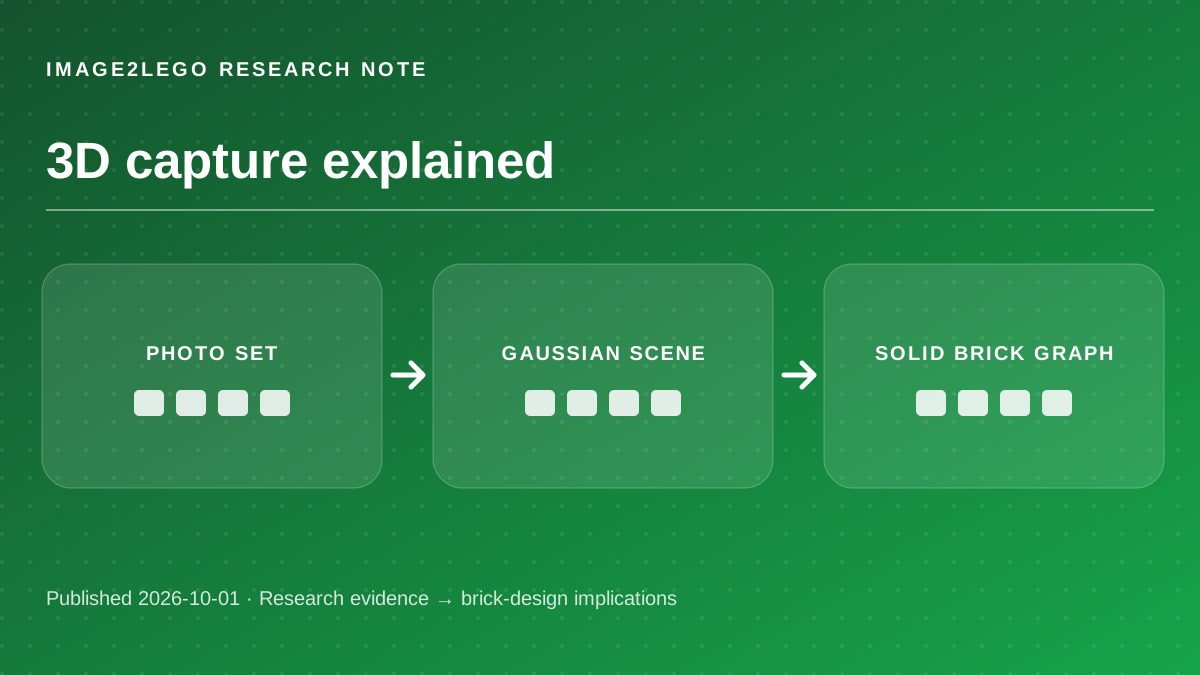
Brick-design analysisA sensible chain is photos to scene reconstruction, scene to coarse solid geometry, coarse geometry to part graph, then graph to instructions and inventory. Each transition needs its own validation.
Before sharing a rendered model as buildable, test connections, collisions and assembly order in a brick editor.
Questions builders ask
Can I convert a 3D Gaussian splat directly to LEGO?
Not directly in a reliable way. You need to recover usable geometry, simplify it, map it to parts and validate connections.
Is a photorealistic scan useful at all?
Yes—as reference evidence for proportions, colors and hidden views, especially when combined with a human review step.
Primary sources and editorial method
Every external capability and research number above is attributed to the original project or standard. “Brick-design analysis” and “Try this” are practical inferences, not claims that Image2LEGO uses the named model or has validated a physical build.
Sources checked October 1, 2026. Research results may depend on benchmark, hardware, model checkpoint and input conditions. No third-party demo video or image is reproduced here.