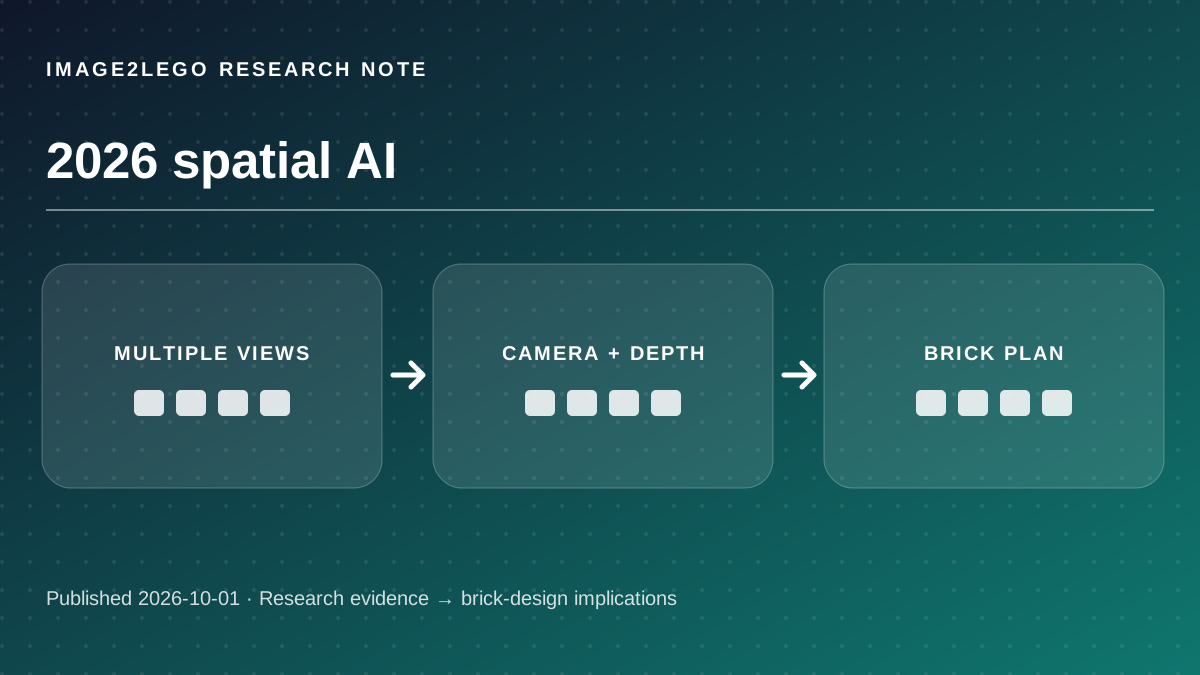
Camera poses help place multiple photos into one coordinate system. Depth can identify which details are protrusions, recesses or separate objects rather than mere shading. The research discussed here is independent of Image2LEGO; this article does not claim that the website implements those systems.
“Reconstruction is a powerful and scalable proxy task”
— VGGT-Ω project page and September 2026 update. Short excerpt quoted for analysis; the source’s results do not measure Image2LEGO.
What changed in VGGT-Ω
Source factThe Oxford and Meta team says VGGT-Ω improves static and dynamic reconstruction. Its project page reports training at about 30% of the predecessor’s GPU-memory use and with 15 times more supervised data. It also reports a 77% improvement over a prior camera-estimation result on the Sintel benchmark. These are published research comparisons, not Image2LEGO performance figures. [1] [2]
Brick-design analysisCamera poses help place multiple photos into one coordinate system. Depth can identify which details are protrusions, recesses or separate objects rather than mere shading.
When photographing a physical object, collect front, side and rear views at a similar distance. Overlap visible landmarks between views.
Why the September update matters
Source factOn September 18, 2026 the authors released training code and a checkpoint from an additional run. They explicitly say the new checkpoint should be the reference for future comparisons on reported benchmarks. [1]
Brick-design analysisA current article should not repeat a headline benchmark without its evaluation context. This matters especially when marketing claims turn a research score into a supposed guarantee for a consumer workflow.
If you compare 3D reconstruction systems, note the checkpoint, dataset and image conditions. Do not infer brick-buildability from camera accuracy.
Reconstruction is not assembly
Source factVGGT predicts 3D attributes such as camera parameters, depth maps and point maps. BrickNet’s task is different: representing relationships among brick parts and their connections. [2] [3]
Brick-design analysisBetter geometry can reduce guesswork about unseen surfaces, but a brick design still needs discrete dimensions, studs, tubes, pins, collision checks and a build order. Those constraints do not appear automatically in a point cloud.
Inspect whether a generated tower has internal support and whether walls connect across layers, not only whether it resembles the photos.
Best use case for builders
Source factThe VGGT family accepts one or multiple visual views; the original repository documents camera, depth and point-map outputs. Performance varies by scene and setup. [1] [2]
Brick-design analysisA practical product could use the reconstruction as a guide for proportion and camera alignment while asking a person to resolve uncertainty. It should show low-confidence regions instead of inventing a confident-looking back wall.
For symmetrical subjects, indicate the symmetry in the prompt. For asymmetrical subjects, supply a second view rather than asking AI to guess.
Questions builders ask
Does VGGT-Ω turn video into LEGO instructions?
No. It is a reconstruction system. A separate part graph, validation pass and instruction planner are needed.
Why use multiple photos if the AI accepts one?
Additional views can reveal hidden surfaces and reduce ambiguity, although capture quality and view consistency still matter.
Primary sources and editorial method
Every external capability and research number above is attributed to the original project or standard. “Brick-design analysis” and “Try this” are practical inferences, not claims that Image2LEGO uses the named model or has validated a physical build.
Sources checked October 1, 2026. Research results may depend on benchmark, hardware, model checkpoint and input conditions. No third-party demo video or image is reproduced here.